
- All
- Product Name
- Product Keyword
- Product Model
- Product Summary
- Product Description
- Multi Field Search


RF connectors are essential components in countless electronic systems, playing a pivotal role in the reliable transmission of radio frequency signals. From high-frequency data transfer to everyday wireless communication, these small devices can significantly impact system performance. With so many different types available, choosing the right RF connector for your application can be overwhelming. In this guide, Otto Cable Technology breaks down the most common RF connector types and their ideal applications to help you make informed, efficient, and cost-effective choices.
RF connectors are primarily used to connect coaxial cables in systems that handle high-frequency signals. These connectors ensure the consistent transmission of signals with minimal loss or reflection, making them essential in both commercial and industrial environments.
One of the main purposes of RF connectors is to maintain the shielding and impedance integrity of coaxial cables, allowing for seamless signal flow in:
Signal transmission: They enable the efficient flow of RF signals between components like antennas, receivers, transmitters, amplifiers, and filters.
Cable connections: RF connectors join coaxial cables to devices in a stable and detachable manner, offering easy installation and maintenance.
Test and measurement systems: They are often used in laboratory equipment and test benches where repeatable and accurate signal transmission is necessary.
Applications across industries include:
Wireless communications: RF connectors are found in mobile phones, routers, GPS systems, and other wireless systems, enabling high-speed data and signal transmission.
Broadcast and television: In professional AV systems and television broadcasting, RF connectors ensure clarity and signal stability.
Radar and aerospace systems: In military and aviation sectors, high-precision RF connectors are crucial for reliable radar and satellite operations.
Medical imaging equipment: In MRI and ultrasound machines, RF connectors help maintain signal accuracy, essential for diagnostics.
Automotive communication systems: From embedded GPS to vehicle-to-vehicle (V2V) communications, RF connectors provide vital links in car electronics.
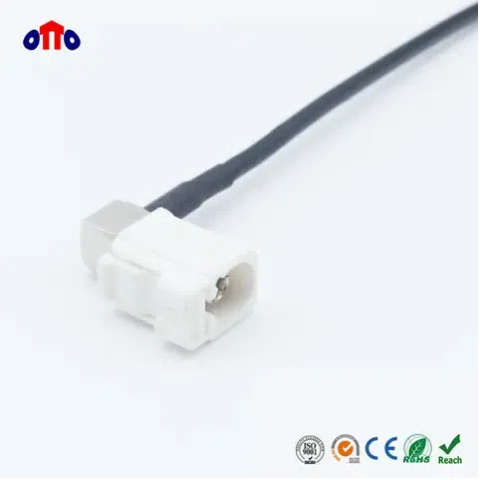
Understanding the different RF connector types is the key to selecting the right one for your system. Each type has specific characteristics that make it suitable for particular use cases.
SMA Connector – Compact and Widely Used for Mobile and WiFi Devices
SMA (SubMiniature version A) connectors are known for their compact size and threaded interface, making them ideal for applications where space is limited and a secure connection is required. Their frequency range typically goes up to 18 GHz, offering excellent electrical performance.
Common uses:
Mobile and handheld devices
WiFi routers and antennas
GPS modules
Low-power RF systems
SMA connectors are often found in environments requiring high performance and compact design, striking a balance between durability and signal integrity.
BNC Connector – Quick Connect/Disconnect for Surveillance and Testing
BNC (Bayonet Neill–Concelman) connectors feature a quick twist-and-lock mechanism, enabling easy and fast connections. While they are limited to lower frequencies (typically up to 4 GHz), their convenience makes them a top choice for short-distance signal transmission and testing environments.
Common uses:
CCTV systems and surveillance equipment
Oscilloscopes and lab instruments
Audio/video systems
BNC connectors are especially useful in applications where connectors are frequently attached and removed, ensuring reliability without the hassle of threading.
TNC Connector – Threaded BNC Alternative for High Vibration Environments
TNC (Threaded Neill–Concelman) connectors are similar to BNC but offer a threaded coupling, which provides greater resistance to vibration and better performance at higher frequencies (up to 11 GHz).
Common uses:
Cellular base stations
Military communications
Outdoor antennas
For systems exposed to environmental stress or frequent movement, TNC connectors provide a more secure option than BNC connectors.
N-Type Connector – Durable Outdoor Option for High-Frequency Systems
N-type connectors are medium-sized connectors capable of handling frequencies up to 11 GHz or even higher, with versions supporting up to 18 GHz. They are known for their durability and are commonly used in outdoor installations due to their weatherproof design.
Common uses:
Base station antennas
Satellite communications
Distributed antenna systems (DAS)
Outdoor WiFi equipment
Otto Cable Technology manufactures N-type connectors that meet rugged environmental standards, perfect for long-term outdoor use.
UHF/PL-259 Connector – Legacy Connector for Broadcasting and CB Radios
The UHF connector, often called PL-259, is one of the oldest RF connector types. Despite the name, it is not suitable for ultra-high frequencies, typically working best below 300 MHz. Though largely replaced in modern systems, it is still used in legacy applications.
Common uses:
Amateur radios (ham radio)
CB (citizen band) radios
Older broadcasting systems
While not ideal for high-frequency systems, UHF connectors are cost-effective and widely available for compatible legacy setups.
Selecting the correct RF connector is about more than just compatibility—it directly impacts signal performance, durability, and installation efficiency. Here are the key factors to consider:
Frequency Range
Every RF connector has a maximum frequency it can support. For high-frequency applications (above 6 GHz), connectors like SMA or N-type are preferable. For lower-frequency systems like CB radio, UHF connectors may suffice.
Interface Style
There are two main coupling mechanisms: threaded and bayonet.
Threaded types (e.g., SMA, TNC) offer better vibration resistance and secure connections, ideal for high-stress or outdoor environments.
Bayonet types (e.g., BNC) are easier to attach/detach, suitable for lab and indoor use where frequent reconfiguration occurs.
Impedance Matching
Most RF systems operate at either 50 ohms or 75 ohms impedance. Choosing a connector with the right impedance is essential to minimize reflection and signal loss. For example:
50 ohms: preferred for data transmission, wireless, and radar systems.
75 ohms: commonly used in broadcast and video transmission.
Environmental Conditions
For outdoor use, ensure your connector is weather-resistant. N-type connectors with sealed housings are better for exposure to moisture and temperature fluctuations. Indoors, simpler connectors like BNC or SMA might be more suitable.
Mechanical Requirements
Consider size, weight, and ease of installation, especially for mobile or handheld devices. Smaller connectors like SMA are ideal in space-constrained environments.
Future Proofing
If your design may be upgraded later, choosing a connector that supports higher frequencies or has industry-wide compatibility (such as SMA or N-type) helps maintain flexibility.
At Otto Cable Technology, we manufacture a wide range of RF connectors optimized for different use cases, ensuring reliable performance across various industries. Whether your system demands high-frequency precision, weather resistance, or compact size, our product lines offer tested, certified solutions with global compatibility.
RF connectors may seem like minor components, but choosing the right type is critical to your system's overall reliability and performance. From SMA and BNC to N-type and UHF connectors, each offers specific advantages tailored to different applications. Otto Cable Technology provides a full range of RF connectors backed by ISO-certified manufacturing and rigorous quality control. Whether you need rugged outdoor options or compact connectors for mobile devices, we can help you find the perfect match for your system.
Ready to find the right RF connector for your project? Contact us today to discuss your requirements and explore our product catalog.